Compressed Air Technology Camaro

Dale Vaznaian was co-founder of Nitrous Oxide Systems [NOS] and was the inventor and patent holder for the first “Fogger Nozzle”. By his own admission he has always been intrigued by the short lived, highly controversial and impressively powerful Funny Car that Mickey Thompson put together in the early 70s using a compressed air supercharging system. A system that was mechanically controlled.
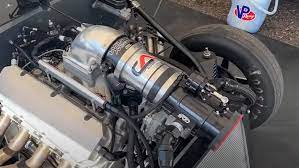
Vaznaian wondered what would happen if contemporary electronic controls were applied to the concept. Having long since left NOS he has teamed up with former NOS Chief Engineer Karl Staggemeier to find out. The upshot is their company Compressed Air Systems [CAS]. Its technology has recently been revealed as applied to Mark Griffin’s current NHRA Top Sportsman contender.

This all-steel ’68 Camaro has a Big Block Chevrolet built specifically to exploit the potential of CAS’ innovative technology. Its charge air is either ambient or is compressed and is fed in through a four barrel type manifold using port fuel injection. Ambient air is used only for running in the pits and the burn out.

Come the actual race and a butterfly seals the induction system from that ambient inflow and the electronically controlled CAS system allows instead a supply of compressed air into the manifold. The car has two rear mounted 38 in long carbonfibre air bottles for eighth mile running with a third such added for a quarter mile dash. It takes about 20 minutes to refill them between runs.

This onboard supply has been compressed to 225 psi and is regulated into the engine such that it [currently] offers up to 3.2 bar absolute manifold pressure. That level is attained from ambient within just four tenths of a second. Since the compressed charge air enters the engine at -30° F detonation is not a danger.

Using CAS’ technology there is decreased sensitivity to air:fuel ratio and to fuel quality. Moreover, the absence of ambient air interaction means the engine performs the same regardless of air density and temperature – track height above sea level and weather conditions do not concern the CAS user. Currently the CAS system is programmed such that Griffin’s unique car exploits over 2000 bhp, allowing it to run the quarter mile in 6.8 seconds at over 200 mph. 

Quick Contact

If you have any questions or need help, feel free to contact with our team.

©CAS, All Rights Reserved.

Build Your 1700HP System

Name
How would you us to contact you
Agreement(Required)

Build Your 3000HP System

Name
How would you us to contact you
Agreement(Required)

Build Your System

Name
How would you us to contact you

Release of Liability & Waiver of Claims

Notice to Customer: This is a release of legal rights. By signing this document, you waive certain claims. Please read carefully.
This Release of Liability and Waiver Agreement (“Agreement”) is entered into by the undersigned customer (“Customer”) in favor of Compressed Air Supercharging, Inc. (“CAS” or the “Company”), including its officers, directors, employees, agents, affiliates, successors, and assigns.
CAS manufactures and distributes high-pressure air systems intended solely for off-road and racing use. CAS does not install or warrant the use of its systems and disclaims any use outside the intended purpose. Customer acknowledges that CAS systems are not for use in
street-legal vehicles or on public roads, and that any such use is undertaken solely at the Customer’s risk.

1. Assumption of Risk

CAS systems operate at extremely high pressures. Improper installation, modification, or use may result in catastrophic failure, fire, explosion, personal injury, or death.

Customer accepts responsibility for installation, integration, and operation of CAS products.

Customer acknowledges risks in high-performance and off-road driving, including collisions, rollovers, equipment failure, instability, and loss of control.

Risks may arise from activity, acts or omissions of others, mechanical issues, weather, or natural conditions.

Customer assumes all risks, including those arising from the Company’s ordinary negligence.

2. Waiver & Release of Liability

To the fullest extent permitted by Texas law, Customer releases CAS from all liability for claims, demands, losses, damages, or expenses—including bodily injury, property damage, illness, or death—arising from or related to purchase, installation, or use of CAS systems,
except where caused by gross negligence or intentional misconduct.

CAS makes no express or implied warranties, including merchantability or fitness for a particular purpose.

All products are sold ‘AS IS’ and are not certified for on-highway use.

CAS is not liable for use of compressed air or gases in unauthorized, illegal, or experimental ways.

CAS is not responsible for injuries, damage, or liability from aftermarket modifications or misuse.

3. Customer Responsibilities

Customer agrees to:
– Follow all written and verbal safety instructions.
– Use appropriate protective equipment.
– Refrain from reckless, impaired, or dangerous operation of vehicles with CAS products.

The Company is not responsible for any injury or damage caused by the Customer’s failure to follow instructions or use safety equipment.

4. Covenant Not to Sue; Indemnification

Customer agrees not to initiate or maintain lawsuits or claims against the Company or related parties for any loss, injury, or damage covered by this Agreement.
Customer indemnifies and holds harmless the Company for claims, liabilities, or expenses (including attorney fees) from misuse or breach of this Agreement by Customer or third parties.
This does not waive liability for gross negligence or intentional misconduct.

5. Compliance with Laws

Customer is responsible for compliance with all federal, state, and local laws, as well as rules of any track, course, or racing organization where CAS products are used.

6. Governing Law; Dispute Resolution

This Agreement is governed by the laws of the State of Texas. Disputes will be resolved in the courts of Burnet County, Texas.

7. Severability

If any provision is invalid or unenforceable, the remaining provisions remain in effect and will be interpreted to best effectuate the intent under Texas law.