Compressed Air Supercharging: Instant Horsepower Explained

When it comes to making power, car builders are always looking for the next edge. Compressed Air Supercharging has been around since the 1960s, and allegedly, Mickey Thompson even tested it before it was quickly banned by the NHRA. It resurfaced around 2014 when legendary scribe Jeff Smith (when he was at Hot Rodtested it. We even dug up this video of him talking about it. Hot Rod also tested “leaf blower supercharging” and other crazy contraptions to remove the “host engine” from the equation when powering the boost-maker.

As they say, what’s old is new again when we spotted CAS at the 2024 PRI Show and then again in this video. It is one of the latest ways to deliver instant horsepower, and it’s nothing like a traditional turbocharger or supercharger. This system feeds high-pressure air directly into the engine. It drastically simplifies boost when you no longer are dependent on the engine to drive the supercharger or turbocharger in any capacity (whether a crank, belt, or exhaust gas). It’s instant power that can be infinitely regulated to optimize for traction. This isn’t science fiction — it’s a straightforward, practical system built for serious performance. Let’s look at how it works.

How Does Compressed Air Supercharging Work?

At the heart of a compressed air supercharging system are the air bottles. These aren’t just regular tanks. They’re built from carbon fiber to handle extreme pressures of up to 3,300 psi. Each bottle weighs around 33 pounds when full, and holds 155 cubic feet of compressed air. Newer models are even larger, holding 200 cubic feet. Systems designed for 1,400-horsepower setups, like those used in drag racing trucks or muscle cars, often run two bottles to keep up with demand.

Here’s a size comparison between a standard 10-pound nitrous bottle and a 155 scf high-pressure air bottle.

The high-pressure compressed air is released from the bottle and passes through a regulator. This critical component steps down the pressure to around 100 psi, or sometimes slightly more. From there, the air passes through a second regulator, that’s adjustable. The beauty of the second regulator is that it gives you control over how much boost you want. Whether it’s 5 psi for a soft launch or 20 psi for maximum acceleration, the regulator ensures the engine sees the exact amount of boost pressure you set.

The air is moved through high-pressure airlines, which are far from ordinary hoses. They are made with aircraft-grade stainless steel fittings. These lines can handle up to 16,000 psi, ensuring no failures under extreme conditions. From the regulator, the air is fed through a standard stainless-braided hose measuring in at AN-20, or 1-1/4-inch in diameter. That line uses standard aluminum AN fittings.
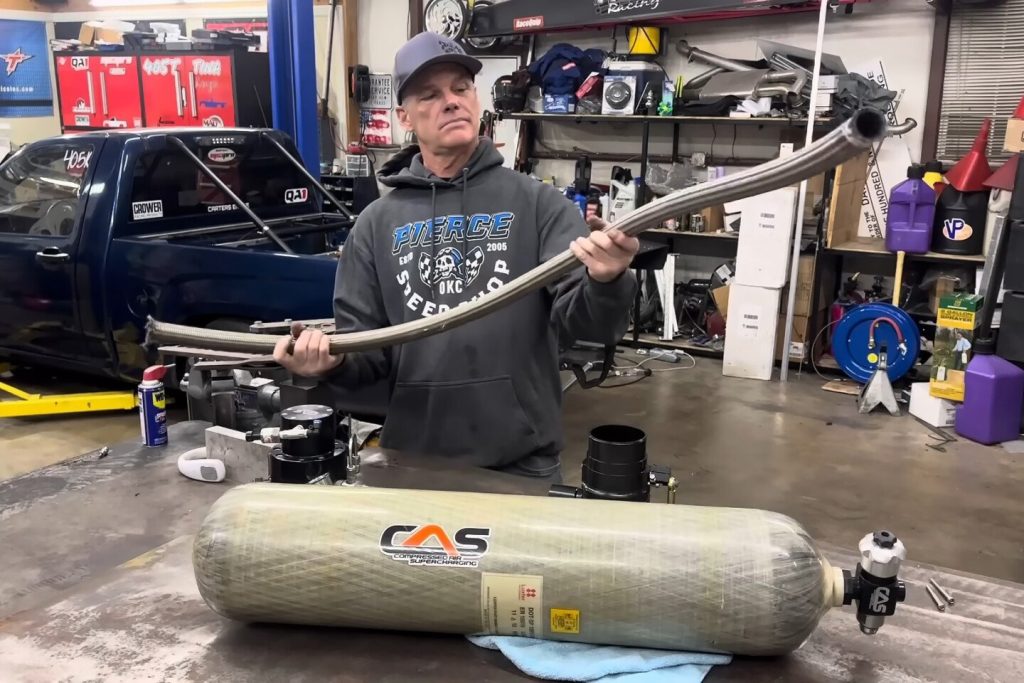
The line from the bottle to the regulator is a special incredibly strong feed line. Post regulator, a more traditional stainless-braided AN line is used, although it’s a -20 size hose.

Once the air goes from the regulator, through the lockoff valve, it hits a Bosch drive-by-wire throttle body that regulates the boost curve of the engine through the run. Finally, the air reaches the ejector valve, positioned near the throttle body. This component ensures that the engine runs exclusively on compressed air during operation, blocking out any outside air, with a throttle-body-style butterfly. This allows the car to drive to the line and complete the burnout naturally aspirated, but switch to the compressed air as soon as the lights drop.

What are the Advantages of Compressed Air Supercharging?

Like nitrous oxide, when the compressed air is released to near atmospheric pressure, it gets incredibly cold.  As the air enters the engine, that cold charge is extremely dense. Actual intake air temperatures as low as -20 degrees Fahrenheit help maximize combustion with the extremely dense intake air charge and keep the engine cool, even during high-stress runs.
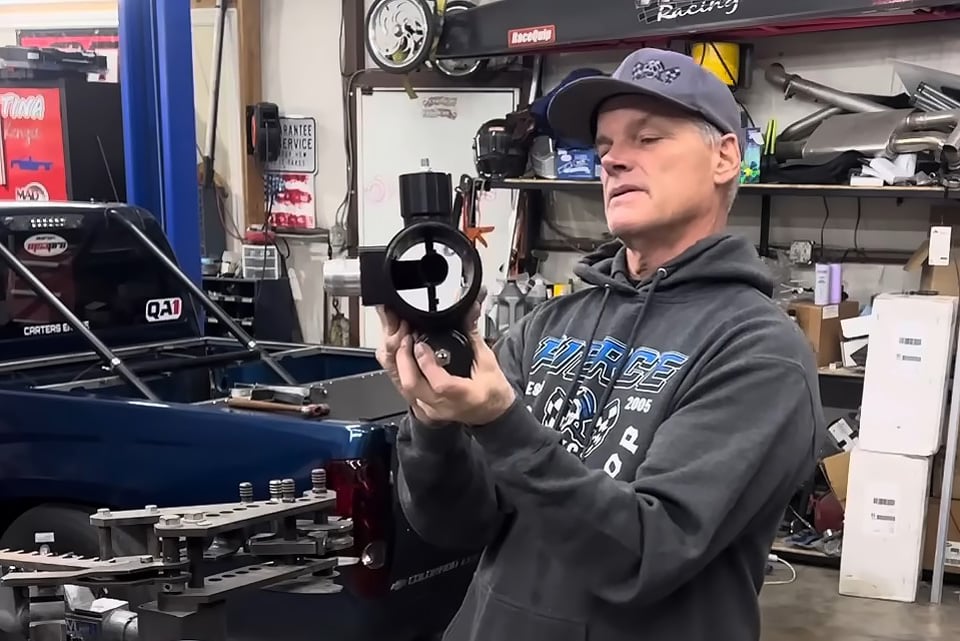
The key to the system is the ejector valve. Not only does it direct the compressed air to the engine, but it also closes off the system to outside air and allows the system to pressurize and run on the compressed air alone.

One of the standout advantages of compressed air supercharging is its cooling effect. Traditional turbos generate heat while spooling, but this system delivers ice-cold air without stressing other parts of the car, like the transmission. This means that a compressed air supercharged vehicle is almost burndown-proof at the Christmas tree.  It could also mean less wear and tear throughout the full season of racing. And it’s atmosphere in a bottle – less prone to being affected by weather conditions.

Another advantage is that there is no parasitic loss, like a supercharger, to drive it. And it avoids the massive fabrication time and know-how required for a proper turbo system.
Quick Contact

If you have any questions or need help, feel free to contact with our team.

©CAS, All Rights Reserved.

Build Your 1700HP System

Name
How would you us to contact you
Agreement(Required)

Build Your 3000HP System

Name
How would you us to contact you
Agreement(Required)

Build Your System

Name
How would you us to contact you

Release of Liability & Waiver of Claims

Notice to Customer: This is a release of legal rights. By signing this document, you waive certain claims. Please read carefully.
This Release of Liability and Waiver Agreement (“Agreement”) is entered into by the undersigned customer (“Customer”) in favor of Compressed Air Supercharging, Inc. (“CAS” or the “Company”), including its officers, directors, employees, agents, affiliates, successors, and assigns.
CAS manufactures and distributes high-pressure air systems intended solely for off-road and racing use. CAS does not install or warrant the use of its systems and disclaims any use outside the intended purpose. Customer acknowledges that CAS systems are not for use in
street-legal vehicles or on public roads, and that any such use is undertaken solely at the Customer’s risk.

1. Assumption of Risk

CAS systems operate at extremely high pressures. Improper installation, modification, or use may result in catastrophic failure, fire, explosion, personal injury, or death.

Customer accepts responsibility for installation, integration, and operation of CAS products.

Customer acknowledges risks in high-performance and off-road driving, including collisions, rollovers, equipment failure, instability, and loss of control.

Risks may arise from activity, acts or omissions of others, mechanical issues, weather, or natural conditions.

Customer assumes all risks, including those arising from the Company’s ordinary negligence.

2. Waiver & Release of Liability

To the fullest extent permitted by Texas law, Customer releases CAS from all liability for claims, demands, losses, damages, or expenses—including bodily injury, property damage, illness, or death—arising from or related to purchase, installation, or use of CAS systems,
except where caused by gross negligence or intentional misconduct.

CAS makes no express or implied warranties, including merchantability or fitness for a particular purpose.

All products are sold ‘AS IS’ and are not certified for on-highway use.

CAS is not liable for use of compressed air or gases in unauthorized, illegal, or experimental ways.

CAS is not responsible for injuries, damage, or liability from aftermarket modifications or misuse.

3. Customer Responsibilities

Customer agrees to:
– Follow all written and verbal safety instructions.
– Use appropriate protective equipment.
– Refrain from reckless, impaired, or dangerous operation of vehicles with CAS products.

The Company is not responsible for any injury or damage caused by the Customer’s failure to follow instructions or use safety equipment.

4. Covenant Not to Sue; Indemnification

Customer agrees not to initiate or maintain lawsuits or claims against the Company or related parties for any loss, injury, or damage covered by this Agreement.
Customer indemnifies and holds harmless the Company for claims, liabilities, or expenses (including attorney fees) from misuse or breach of this Agreement by Customer or third parties.
This does not waive liability for gross negligence or intentional misconduct.

5. Compliance with Laws

Customer is responsible for compliance with all federal, state, and local laws, as well as rules of any track, course, or racing organization where CAS products are used.

6. Governing Law; Dispute Resolution

This Agreement is governed by the laws of the State of Texas. Disputes will be resolved in the courts of Burnet County, Texas.

7. Severability

If any provision is invalid or unenforceable, the remaining provisions remain in effect and will be interpreted to best effectuate the intent under Texas law.