

Since the dawn of the petrol head, we’ve been experimenting with new ways of jamming air and fuel into engines to make more horsepower. Belt-driven superchargers, nitrous and turbos are our faves, but there’s another, less conventional way of jamming air into an engine: bottled, compressed air.
Gallery 1
The idea has been kicked around since at least the early 1960s but now it has seemingly been perfected by US mob CAS Compressed Air Supercharging. CAS is headed by Dale Vaznaian and Karl Staggemeir and they reckon they’re right on track to blow compressed air (excuse the pun) right onto the drag racing scene in a big way.

Mark Griffin’s 1968 Top Sportsman Camaro was recently profiled in an NHRA video using the CAS technology, a car that runs in the 6.80s at over 200mph using compressed air.
What is the power potential of compressed air supercharging?
When Mark starts spelling out the stats we guarantee your eyebrows will be heading north. The 650hp 540ci big-block bowtie is shoved up to 2100hp when hit with the compressed air, which equates to around 32psi of boost if it were a conventional blower setup.

The engine runs solely on the compressed air during a drag run, only using atomosphere for transit to to lanes and the burnouts.
That means the air density and temperature is fully controlled once the car switches to the 100 per cent onboard air. That means bracket racers don’t have to worry about altitude affecting their power at each track, and the air temperature of -100 Fahrenheit entering the engine means there’s zero detonation.

What gear is needed for a compressed air supercharger?
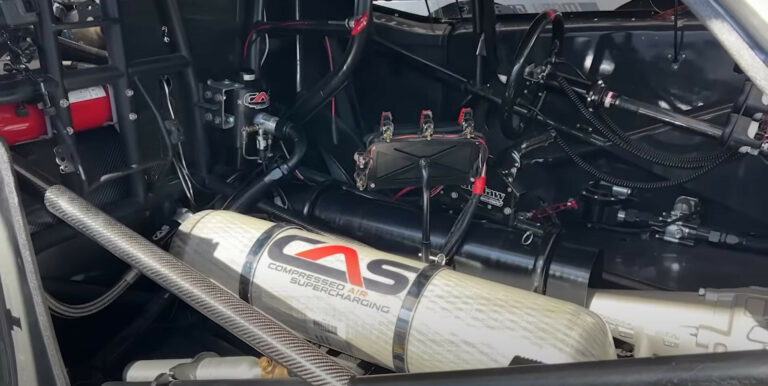
In the car you’ll find three tanks of air (two in the boot, one beside the driver) that hold up the 3300psi each, which send air to the engine through a series of regulators and valves, along with a pair of -20AN lines that feed to the intake.

The system is electronically controlled, with Mark going shutting out all atmospheric air in less than a second from getting out of the hole. Two bottles are used for eighth-mile runs, with the third added for quarter mile duties.

As for filling the bottles, it’s not as strenuous as one may think. Granted, Mark does have to travel with four ‘mother bottles’ in his race trailer to fill the ones in the car, but filling is done with a quick connect coupling and only takes around 10 to 15 minutes.